
Why Race Matters
The healthy and vital role of a natural racial consciousness, and the bedrock of identity and nationhood

With regard to how we see ourselves and others, how we frame and conceptualize our understanding of the world, you’ll often hear confident proclamations about what matters most—and in truth, we all get to subjectively choose.
Some people are all about political ideology, and largely rank and measure a person based on how like-minded they are on this spectrum. Others prize a certain philosophical worldview above all else, and see life philosophy as the “parent” of the merely political, the root from which the political merely springs, and thus prize those of similar philosophical leanings.
Others consider the spiritual to be the parent of all, and have an extremely powerful argument to make in defense of this idea.. albeit an argument that might increasingly fall a bit flat or fail to resonate with some in our age of deeply corrupted religions, superficial and disoriented spiritual understanding, and an environment seemingly so purposefully muddied and polluted by subversives, frauds, incompetents, and charlatans—often to the point that the majority of those looking on are left with such a bad taste in their mouths that they tend to “throw out the baby with the bathwater” and aren’t able to take any spiritual understanding seriously.
Others believe culture to be all-important.. while others believe race, lineage, and genetic heritage to be a dominant and central factor worthy of consideration.
In this article, I’ll try to speak to the forgotten and neglected importance of the latter of these.. in part because I think it’s helpful to try to redress this imbalance in our collective modern understanding, here.
But on what grounds, you might ask—because all of the above have a subset of defenders arguing for them as the factor of genuine importance, isn’t choosing between them just a purely subjective and personal choice?
And it’s true, all of the above are important in their own way—all are frameworks that are a single convincing argument away from being powerfully embraced and adopted as a prism through which someone views their world. However, all-importantly, the latter does have a crucial defining characteristic that makes it truly different from all of the others:
It is real - in that it is intrinsic, innate, biological, literally coded into our very being. It’s also natural, and naturally recognized, at a single glance. It’s not just prison yards or school cafeterias that tend to self-segregate organically, but studies show even the youngest children and infants both recognize and have a positive opinion of their own group and intuitively seek to draw closer to them.
On some level, we all recognize family.
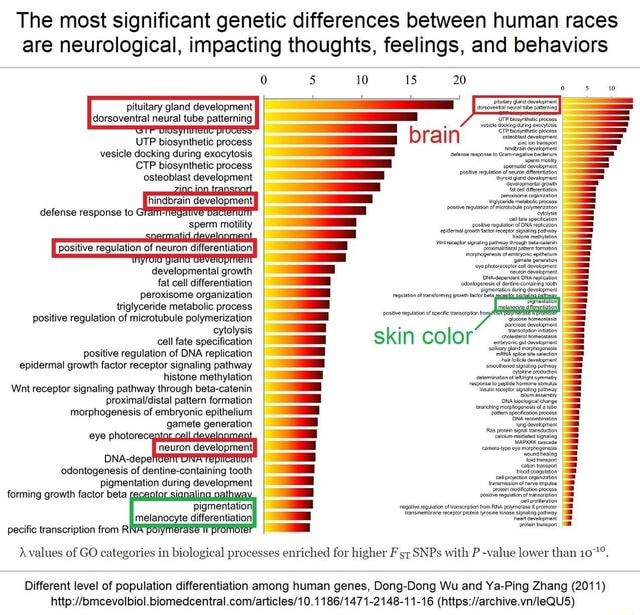
We’re literally designed and programmed to do so. Believing this to be a mistake—whether God’s mistake, Nature’s, or the Universe’s—seems a wild speculative stab in the dark that completely misses the mark. Unlike a political affiliation or a philosophical ideology, a mere conceptual framework which might be casually picked up one day and discarded the next, our blood and our DNA are a permanent fixture—and quite literally shape nearly every last aspect of our very being: our hair and eye and skin color, our facial features, our raw and inborn intelligence and level of overall cognitive function, and even many personality traits.
Even our skeletal remains differ significantly, allowing the racial background of those in ancient graves to be approximately discerned without genetic testing - and in fact hospitals now seek racial background information on organ donors, to help ensure the organ isn’t rejected by the receiver. Sadly, many mixed race children often aren’t able to receive transplants from either one of their parents without greater risk of complication.
And this is just the topmost tip of the iceberg.. the full list of biological and psychological realities that so powerfully correlate most heavily with racial heritage is as long as it is fascinating.
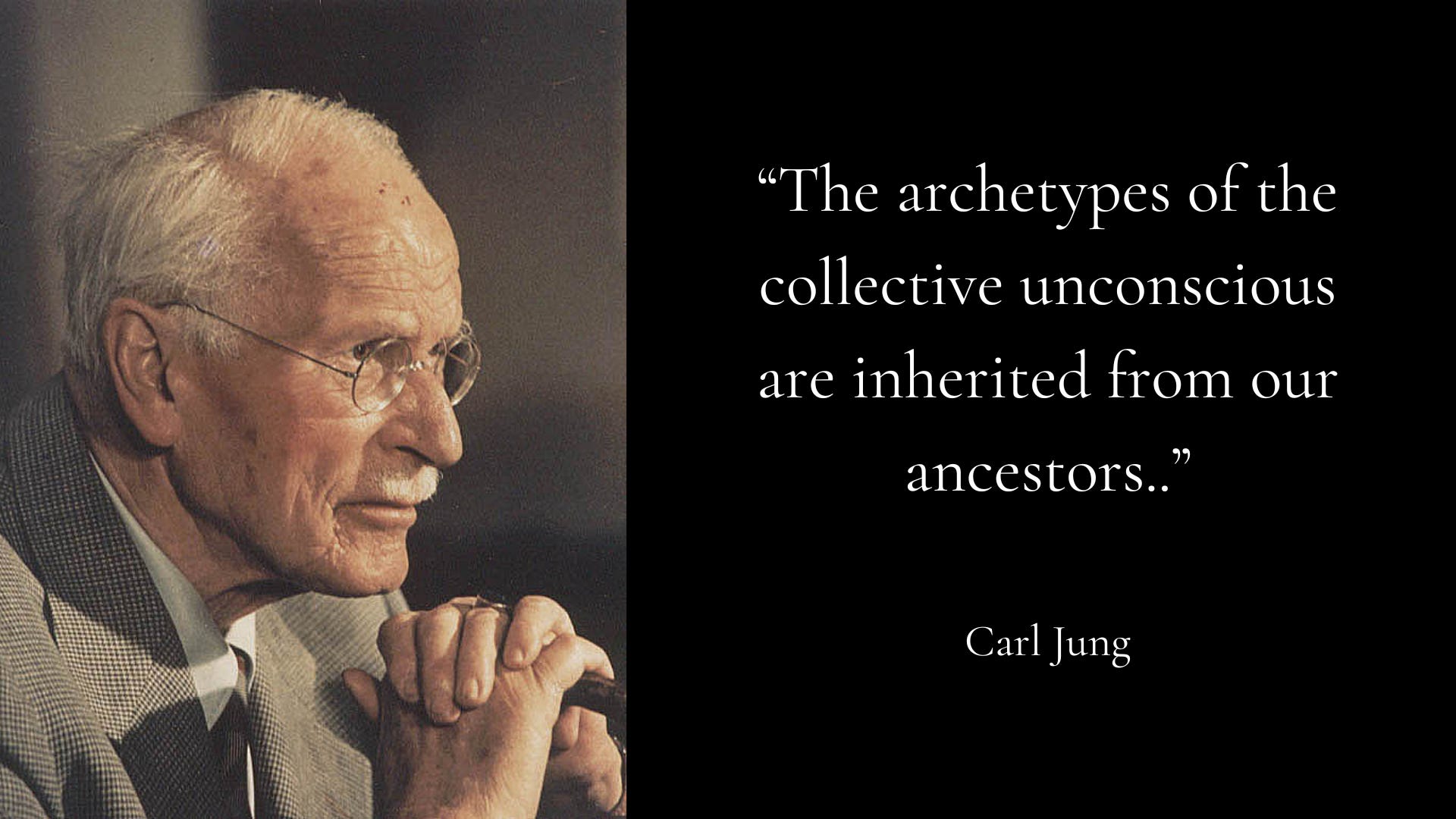
Even more than this, as the intriguing realm of epigenetics (the study of how environmental factors and behaviors can change how genes are expressed) is revealing, in proving that even the experiences and environments of our ancestors are reflected in our code: we’re an unfolding storyline of our line and lineage.
We’re all a living compilation of those who came before us—literally a creation of theirs, in their image.. just as they were a creation of their parents, who were a creation of theirs—just as we continue this beautiful chain of existence through the creation of our own children.
This inherited legacy, etched into our very DNA, naturally raises the question of how much of who we are comes from that lineage versus the world we’re raised in.
The debate as to whether ‘nature’ or ‘nurture’ is most to credit or blame for our specific type of development rages on—but it’s obviously become politically correct (and academically safe, expedient) to lean toward the latter, and work to dismiss the former.
I strongly believe this to be a mistake.. and a costly mistake we’re stumbling into for all the wrong reasons.
Some of the most fascinating studies I’ve ever uncovered have been those like the ‘Minnesota Twin Studies’, in which a large handful of children who were genetically identical twins were monitored after having been separated from birth—and sometimes into very different households, with starkly contrasting socioeconomic status and standard of living.
Not only were their IQs extremely similar, despite their nature having been exposed to such polar opposite nurture, but when several of these twins were reunited for the first time, after an entire lifetime of being unaware of one another, they’d frequently find they had a truly unbelievable amount in common—sometimes right down to their occupation, the type (even color!) of car they drove, their taste in music, art, partners, etc.
It all seems incredible, and yet this type of thing is recorded time and time again by similar sets of identical twins who only come to reunite later in life.
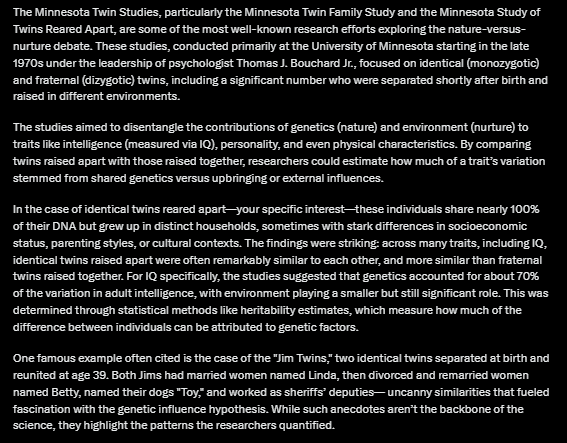
The only reasonable explanation for this so often being the case (especially the case of IQ being so similar, despite vastly different socio-economic backgrounds and formal schooling) seems to be the extraordinary power of nature over nurture. Both are incredibly key, both have their own massive shaping and orienting power, but the more I learned here, the more nature seems to possess the far greater impact of the two.
“Fair enough,” you might say, “but why does this make racial background an important factor of focus and concern for a nation?”
Understanding how dominant a role nature plays relative to nurture should, rationally speaking, change the way we all look at these issues. It’s definitive scientific proof that we are not blank slates, as we come into this world.. far from it. The clear implication is that exceptionally capable men are much more likely to have exceptionally capable children, and thus that replacing the sons and daughters of those men who most fundamentally built our Western nations with millions of sons and daughters of men who did not—and I’d confidently argue could not—is a recipe for disaster, and a roundly terrible decision.
It’s a fundamental downgrade.. and one that threatens to all but ensure our offspring don’t have a chance of enjoying the types of safe, secure, healthy and positively shaping environments many of us were blessed with growing up. It’s self-interested, short-sighted, unthinking lunacy.
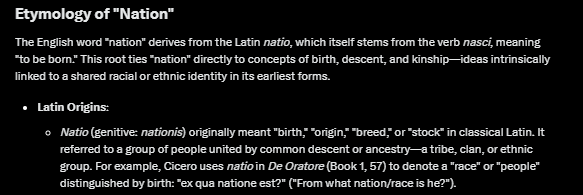
A nation is an extended “family”.
This is how the term was always defined and conceptualized - and it might even be fair to say nations tended to survive and thrive according to how cleanly they fit this definition.
Importantly, if you were to look at nations around the world and statistically chart and measure their “positive” attributes (literacy, life expectancy, infant mortality, per capita income, etc.) or “negative” attributes (criminality, parentless households, etc.), I’m not aware of any other single factor—outside of race—that correlates more fully, or seems to “predict” as reliably and consistently. This type of “success” across statistical categories seems further compounded within nations by their degree of homogeneity, with places like Finland or Japan or Iceland scoring especially well on these and all similar positive measures, to give just two examples of many.
The modern self-professed “expert class” might wish to wag a finger here, and exclaim “correlation is not causation!”, and it’s probably true that any intelligent or knowledgeable person could weave a sophist-icated, manipulative yarn and produce a complex set of reasons as to why the incredibly striking statistical figures here aren’t really screaming what we all think they’re screaming—but the most logical and rational approach here is that the simplest explanation is likely the most true, that mental gymnastics are not needed here and are only unhelpful, and a historical understanding of the world and its varied peoples seems to further back this notion up.
Ironically non-White peoples often seem to be the first to recognize and admit this - notably with many Japanese or similar peoples visiting America and Europe and being baffled at our rate of demographic change, baffled at why we seem so intent on racial and cultural suicide. They see beautiful pictures and videos of past conditions, and travel to see and experience this beauty, only to walk away stunned and disappointed, in many cases.
If modernity has taught us anything, it’s that diversity is most certainly not a strength. We could hardly ask for a greater number of glaringly obvious examples of this. Bringing vastly different types of people, languages, cultures, religions, and ability levels under a singular roof and simply hoping for the best is practically a guarantee of tremendous (and wholly unnecessary) friction, dissipated energy, and a plummeting collective sense of unity and social cohesion. Each distinct group, inevitably, fights for its specific notion of the future, which often leads to their pulling in several directions simultaneously—like a wagon hitched to several horses spread chaotically in a circle. They pull and pull, largely cancel one another out, and the wagon moves nowhere—or perhaps even breaks apart in chaotic shambles, never having served its purpose.
A person simply can’t reauthor countless generations of accumulated culture, or tens of thousands of years of genetic wiring, the moment they set foot across an arbitrary border line drawn on a map. We carry these immutable differences deep within us.. and as we’re forced to live side by side, such deep differences are bound to cause issues that no amount of wishful thinking in the world might solve.
In such unnatural conditions, people gradually and inevitably come to view their fellow citizens as strangers, their nation as equivalent to a stadium or marketplace or hotel, and formerly important concepts like nationhood and citizenship begin to lose all of their magic and power and meaning.
I’d suggest our various branches of brother or cousin peoples—for example, those belonging to the Indo-European language family, or those handful of varieties of European that went into the creation of the American “White” culture—possess more than enough diversity of thought, of culture, of genetics, of thought and speech and art and modes of living, etc., to make for a healthy whole.
It’s not just differences that should be lauded for their own sake, but potentially positive differences—just as it’s incredibly dangerous to laud ‘change’ for its own sake, rather than specifically and exclusively seeking out net-positive change.
These deeply related yet simultaneously distinct European cultures represent something like slightly different versions or variants of the same ancient song.. and by listening closely to each, intuitively noting the similarities and differences, we draw closer to uncovering (and I’d suggest in part rediscovering) a beautiful and timeless melody.
Despite what our dominant parasitic financial interests tell us, we’ve never actually had a need to import the world—least of all, deeply foreign cultures and peoples with whom we share no real bond or preexisting connections. This type of misstep and misunderstanding is no minor thing.. if not recognized, ‘checked’ and corrected, it risks costing us virtually everything of real value, in time.
We are not economic cogs intended to be swapped in or out to power merely economic machines, because we’re not blank slates, ‘tabula rasa’ - we each carry within us a specific coding.. and this coding differs massively. Racial heritage is a most obvious and direct example and result of this coding, on a collective level.
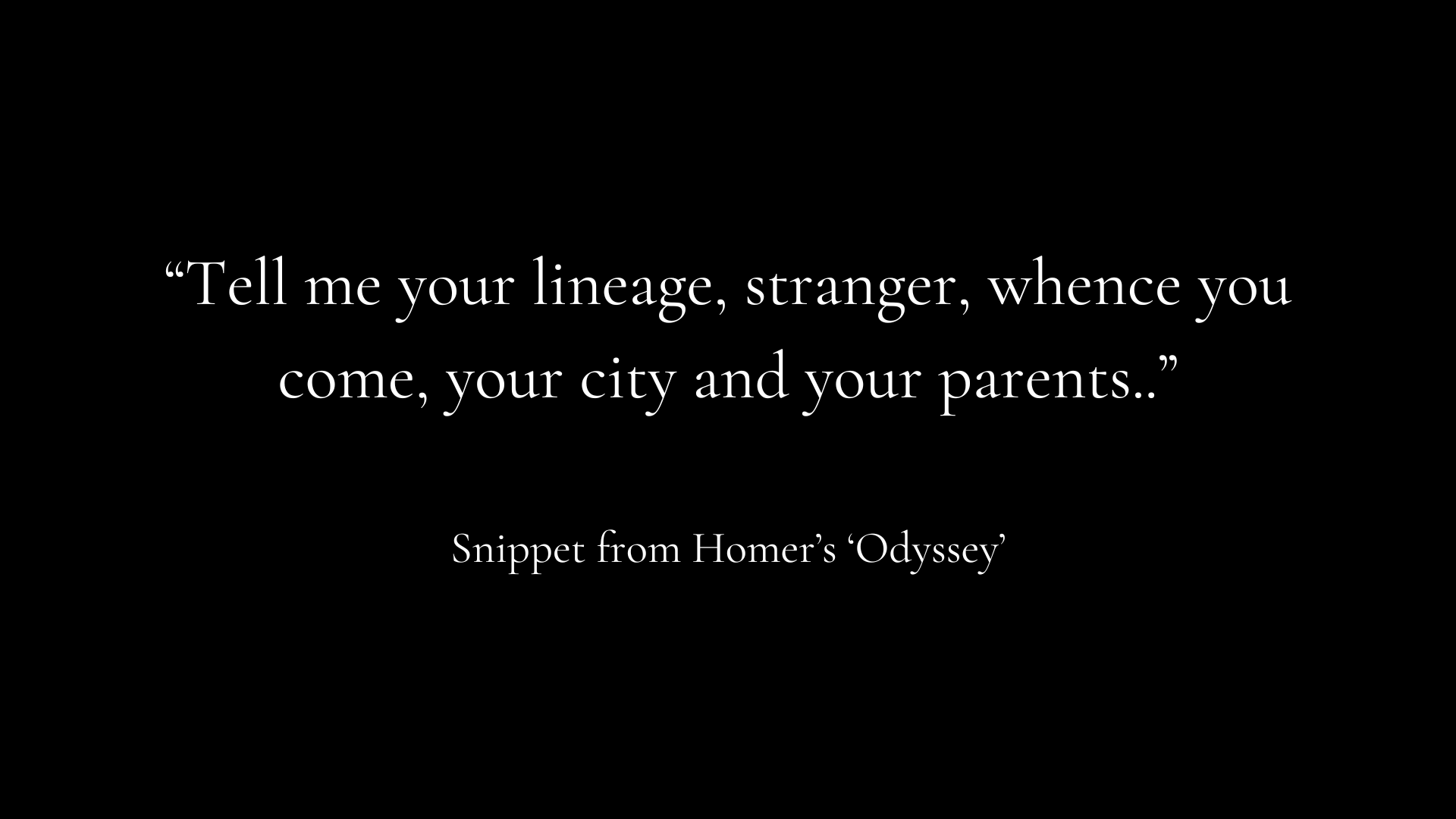
When we pull back to look broadly at the vast tapestry of human existence, I’d suggest racial heritage emerges not as some shallow divider, but as a genuinely substantive thread woven deep into the fabric of who we are—individually and collectively. It’s no small matter that great men of prior ages would first and foremost cite their lineage, their ancestral descent, when speaking to who they fundamentally were as individuals.. pointing to the great men and peoples from which they hailed. They recognized, clearly, that the same blood flowed through their veins, and that this was the furthest thing from meaningless.
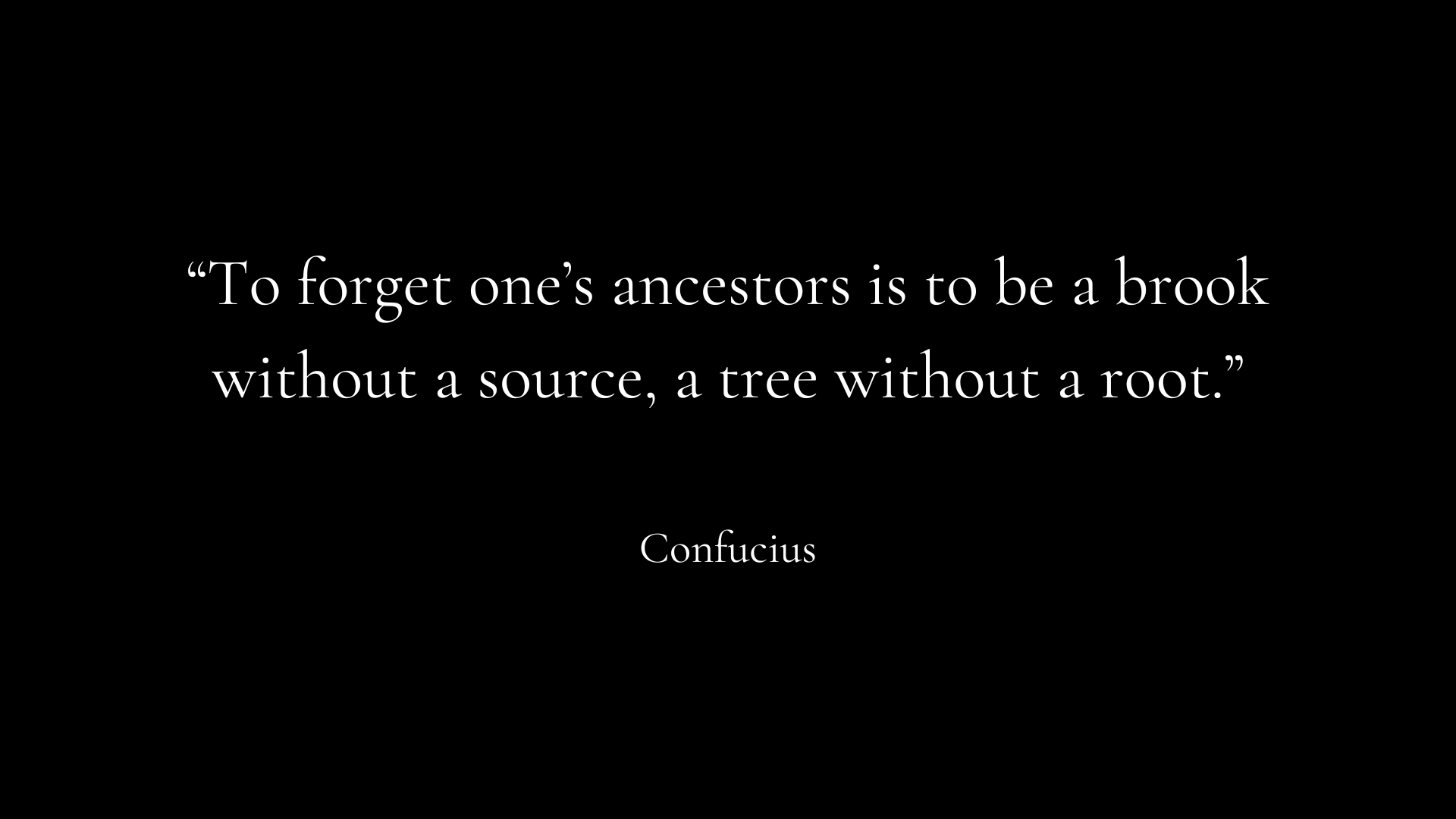
In any community, knowing where you come from gives you some real stake in where you’re going, and some direction and compass coordinates in the process. Race ties us to a family, a lineage—a story that stretches back through time. It’s the echo of our ancestors’ triumphs, struggles, and collective wisdom. A living record of their story, ideally safeguarded by a recognition that we ourselves represent the living continuation of this grand story.
In its most healthy and ideal manifestation, racial consciousness possesses the power to anchor us, allow us to place our feet on solid ground—prevents that type of rootless apathy and hollow individualism that erodes any and all sense of shared purpose, shared responsibility, familial love and devotion.
It’s no accident or coincidence that the racial consciousness of peoples of European descent seems to be the foremost target of a deeply corrupted status quo, and their creative machinations.
Through some strange black magic, we’ve somehow been made to forget the inspirational and aspirational net effects of that type of healthy pride stemming from an understanding of our history and roots.. and this is a genuinely terrible development, and one that makes us fundamentally weaker.
There’s something naturally stirring and inspiring about understanding that your people—your race, your extended family—built the most beautiful temples and cathedrals, filled the grandest libraries with works of wisdom and erudition, crossed the largest and most daunting oceans, repeatedly carved out a life against even the most brutal odds as the most courageous and inventive pioneers, and subsequently crafted the most beautiful high cultures and the most advanced civilizations the world has ever seen.
It’s not that type of petty, selfish, and self-absorbed modern pride so common among ultra-individualist cultures today, but a pride that extends well above and beyond the mere self, and our asymmetrical fallibilities.. and by recognizing the greatness of our fathers, uniquely speaks to—and sparks—our own innate potential.
It’s fuel.
In ideal conditions, that sense of “we did this” possesses the unique power to spark the next generation to think lofty thoughts, to aim ever higher, to add their chapter to the story, to do justice to (and live up to the standards of) their fathers. Healthy racial consciousness has the power to turn history into a living thing, not a museum piece.
This couldn’t possibly be more necessary, right this moment.
Many of us are coming to recognize the almost unbelievable rate at which peoples of European descent are disappearing, relative to the rest of the world. I recently read a history book authored in approximately 1850, in which the author estimates the total number of individuals around the world at the time in each of approximately eight different racial categorizations. He estimated the White population as the highest population of all of these eight groupings—less than a mere 200 years ago.
This is certainly not the case any longer. By best estimates, we’re now at less than 10% of the world’s population, and declining fast.
All things considered, it needs to finally be simply said aloud, and with confidence: There is something worth saving, here.
No man should feel the least bit of shame for such a statement—very much the opposite. And yet, it’s not just about preserving something wholly unique, but also preserving excellence—and most specifically preserving the excellence within that wholly unique thing—stoking it, cultivating it still further, providing more room for it to bloom.
I’d suggest the aggressive pendulum swing that occurred post-WWII caused much of the Western world to develop a profoundly unnatural and unhealthy psychological complex about race, causing us to embrace the most immature, unscientific, indefensible reasoning, largely out of reactionary fear of what we believed the National Socialist Germans represented. Yet the data itself, the fact picture and the statistics, past history and present reality, all remained unchanged, in spite of our newly changed opinions. In other words, our faulty and malfunctioning modern compass no longer allows us to understand or navigate the world proficiently.
We’ve since stumbled into the most powerful and all-pervasive delusions—and for decades, up until very recently, the more deluded the man in this regard, the more credentials and accolades and praise he’d tend to receive in this sphere—thus, the more powerful and powerfully trusted were his conclusions, and thus the more deluded we all gradually and inevitably became. A vicious cycle, and one that’s led to a near total inversion of the truth, a re-authoring of everything we knew about race and genetics—a poisoning of the academic and scholarly well.
When race isn’t being used by academics to attack or denounce ‘Whiteness’, it’s often being hypocritically and contradictorily labeled a mere ‘social construct’.. but this is hardly a serious, adult, mature perspective. According to the ‘logic’ employed here, every group label might be viewed as a mere social construct. This couldn’t be a less rational or helpful approach.
It isn’t terribly complicated:
Nations quite simply need things in common, in order to be strong, confident, self-assured, purposeful. The more fundamental things the people within a nation share in common, the more brotherhood is naturally and easily felt, and the more clear and singular their collective purpose might be (and become) as a result.
Yes, it’s excellent when a nation can share similar political leanings, philosophical or ideological conceptions, spiritual understanding, and culture—and to some degree, cultivating some unity in these regards should always be a goal—but I’d suggest race is an even more powerful and real tie and unifying bond, and one which often helps stoke and feed into all of these others. After all, we all intuitively sense who we are and where we come from.. running from this natural reality does not change it one whit. It only makes us additionally unhappy, and our homelands increasingly disordered, dangerous, and drained.
Nations that deny this simple reality are destined to gradually become unnatural monstrosities - and experience the most immense lack, as result of it.
A nation that seeks to represent everything and everyone ultimately represents nothing and no one. This globalist and internationalist idea that all human beings are the same and can be mass-imported to mix freely and seamlessly—an idea pushed by sprawling corporate constructs and feckless billionaires and corrupt governments—is a deeply sick and unnatural worldview, one that results from viewing all the world as a purely economic engine, and viewing all things and people through a purely financial and economic lens. This is peak materialist and reductionist nihilism, and it not only cheapens every nation, and every last one of us—it gradually cheapens life and existence itself.
There has to be more to life than this—there must be a greater depth, greater meaning, a greater degree of real and meaningful purpose.
There must be, and there is, and always has been.
As of late, we’ve just chosen to ignore it—or rather, we’ve been coaxed and psychologically conditioned into ignoring it—at our own peril, and great cost.
The first step in meaningful and positive change is to cease lying to ourselves and others. There are no “noble lies”, because dishonesty is never noble. We can be honest about race, and its place and importance in the world today, without being hateful, or oppressive, or cruel, or unjust—merely being truthful won’t change us into monsters overnight. In fact, I’d strongly suggest it’ll eventually do the opposite.
As an all-important final note - all scientific or intellectual reasoning aside, it’s not just the head that points us in this direction, but the heart. There’s a unique comfortableness, ease, grace, and beauty, that only arises among family.. a unique type of love prevails. A wholesome energy.. something that can’t be fully measured or quantified, but we all recognize it for what it is, to the degree that we allow ourselves to. We deserve this, again.
A genuinely beautiful future awaits us, the moment we’re capable of fully discarding the poisonous indoctrination we’ve suffered at the hands of money men, and recognizing our potential, and our destiny.
Truth is the ultimate antidote to what currently so ails us..
May we all find the principled courage to continue to speak it, despite the momentary costs.
I will never tire of that video. Of watching Victorian ladies (who look like my grandmothers) in their aprons and Gibson-girl hair, joyfully joining in playing in the snow with a bunch of grown men. Too much, we think of our ancestors as dour, stodgy... but they were full of joy and laughter. Full of merriment and fun. It's an important thinknto remember: yes, we get our sense of adventure, courage, and creativity from our forebears, but we also inherit their laughter and joy.
Thank you Asha Logos, you have put into words that which I feel in my heart. To me, books, movies, they all are a key to unlock that, which is within us, the truth, the heritage handed down to us by our forebears. Today these roots are cut off with malicious intent, as artificial roots are put in its place. I know the tear-producing joy, when I, through reading, unlock a memory or connection within myself. This way I have not only put together most of my origins, but also, what lead to the world being as it is. Tolkien's Silmarillion and the Santia Wedes of Perun, written about 40000 years ago helped me a lot. Therein the word race is explained as derived from the first four fair tribes to inherit this earth, the great Rasa, who for a time, lived in Hyperborea and the travelled to colonise the earth, teaching other races (The Hopi talk about a white race welcoming them where they now live, teaching them language, farming and other things before moving away). I only found the first book of the Santia Wedes translated from Russian to German, and I suppose it is no use to you, unless it is in English?